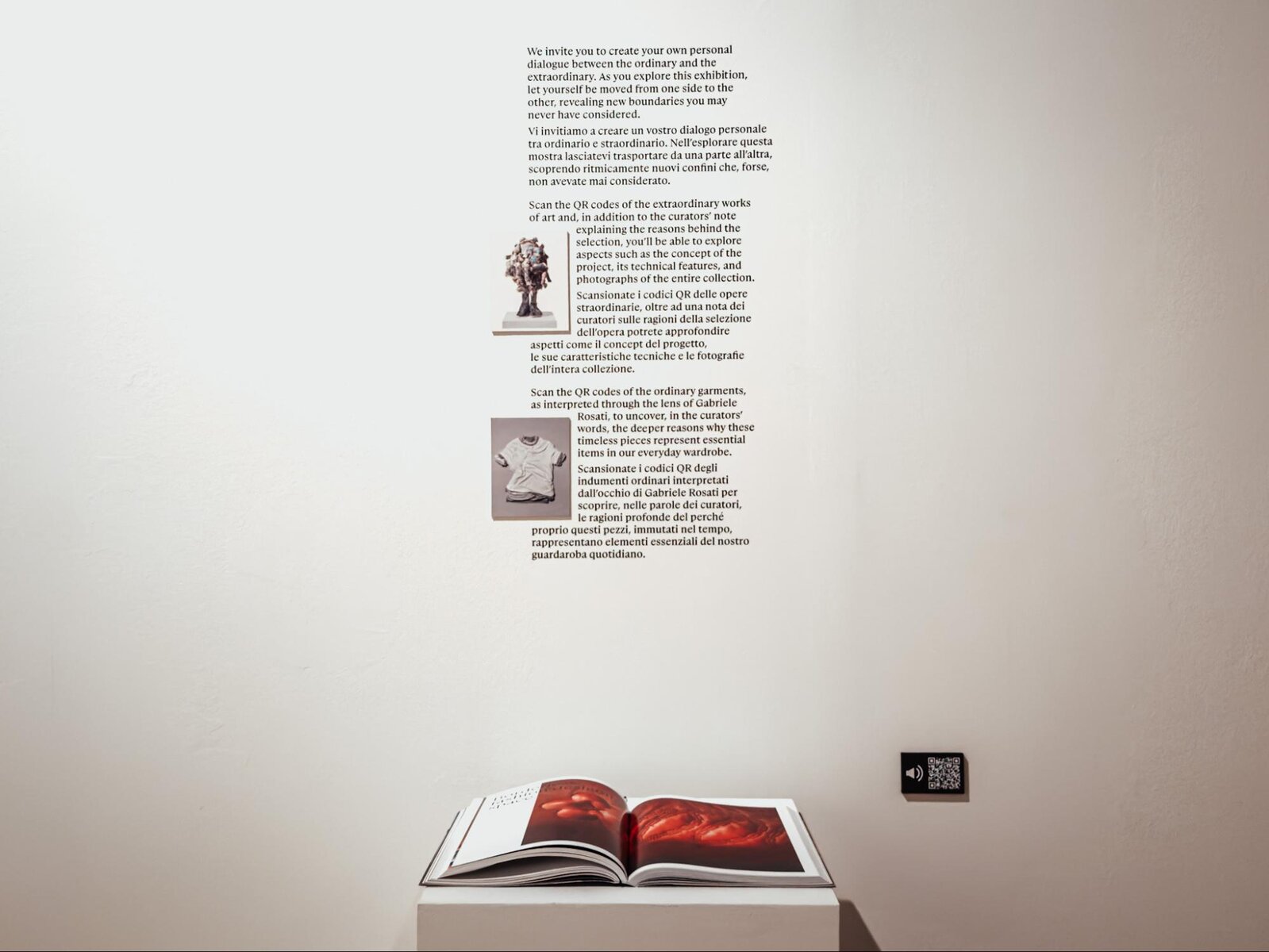
Much More Than Just a Catalogue – Take home a deeper dive into the reasons of “Fashionlands – Clothes Beyond Borders”
30 July 2025
“The most obvious and everyday boundary that fashion never ceases to cross is that between ordinary and extraordinary clothes. We can wear special clothes for ordinary occasions and vice versa. Their diversity seems instead to resemble the distance that exists between waking and dreaming. We ask certain garments to become anchors for us, in order to live in the world around us. Our soul does not essentially belong to the events and landscapes in which it moves and often it wouldn’t even want to stay there. Ordinary clothes are often moorings, harpoons through which we attach our attention to our surroundings, we try to blend in anonymously with the world or instead delegate a presence that we are unable to produce with our psychic powers alone. Extraordinary clothes, on the other hand, are real vehicles that allow us to inject into our daily experience the experiences that we usually reserve for dreams.”
This is one of many reflections offered by fashion historian Olivier Saillard and philosopher Emanuele Coccia in the catalogue of Fashionlands – Clothes Beyond Borders, which provides a deep dive into their curatorial approach for the exhibition but most importantly, a unique view of what fashion actually is. And Oscar Wilde might have summed it up best. “Fashion”, says Lord Goring in The Ideal Husband, “is what one wears oneself. What is unfashionable is what other people wear.”

In such a subjective point of view on what we wear, the land of fashion has allowed itself to be everything and nothing, a dimension that constantly eludes definition, incessantly crossing and tearing down boundaries. A land that could be compared to a Pangea, says Emanuele Coccia, an almost mythical geological theory of when the continents were once united as one, then separated by the movement of the tectonic plates, in a journey that forces them to separate and join up again, cyclically.
“The land of fashion”, say Olivier and Emanuele, “could be compared to this dance of immense spaces with variable configuration, capable over time of separating and melding again without pauses. Even if for this very reason borders and frontiers are the simplest way to map it, it is important to remember that these are ephemeral lines, often imaginary, traced in an immemorial past and often now devoid of real meaning.”
In such a constant movement and reinvention, in this space where fashion is capable of summoning “all eras, past, present and future in an immaterial yet perceptible present”, dreams turn into a reality that stands the ages – the ordinary garments – and reality offers the ground to leap towards the dream – the extraordinary garments. These are not two faces of the same coin, rather continents facing each other, with an underlying magma of creative force which can shuffle the cards bringing the ordinary into the extraordinary and vice versa.

This is precisely why the setup of Fashionlands – Clothes Beyond Borders cannot be defined as a division between examples of ordinary and extraordinary garments: they actually face each other, ready to build bridges and leap from one direction to the other. Because a t-shirt has once been a revolutionary garment allowing us to dream: when Brando and James Dean wore it for the first time – a garment that had been military underwear up until that very moment – it was the kind of moment that Olivier Saillard would define as “a punk moment”. A breaking of the rules, a cracking of tectonic plates redefining what could be done. Reminding us that constant questioning and redefinition might be fashion’s most exquisite quality.

“If fashion has become this socially universal power”, says Emanuele, “capable at the same time of expressing the most elusive idiosyncrasy while remaining legible to anyone, it is only because it has been able to construct visible figures and patterns that express the generic nature of human life.” And these visible patterns are garment that at a certain point in time (though without losing the ability, in a potentially distant future, to leap again into the extraordinary) have crystallized, becoming those “harpoons” which allow us to cling safely to the island of everyday life in the streets of the world: “What the ‘ordinary clothes’ section of the exhibition does is to attempt to capture these original gestures of fashion, the features, forms through which it designs patterns that have not been created by a designer or creator, and do not express a particular aesthetic intention, but a categorisation of an aesthetic nature, a sort of anthropological palette.”

Thus becoming foundational pillars, they allow us to observe the extraordinary recognising prototypal shapes which provide us with the confidence that yes, we are indeed still looking at fashion but devoid of consciousness, graciously departed into the deeper land of the subconscious, of what we rarely display in public. The creative energy isn’t for the faint of heart nor is it something we are willing to lay on the table on an everyday basis. The extraordinary in fashion is not extravaganza per se: it still telling us that we need – every once in a while – to shake our convictions and be willing to redefine what we thought was expected.

Besides cataloguing – as a catalogue should do – the artworks on display, the catalogue of Fashionlands – Clothes Beyond Borders, could turn everything you believed about fashion on its head, open new doors on an awareness that wasn’t there before. It might also make you look at your own wardrobe at home in an entirely new and unexpected way.
You won’t be disappointed to add it to your library.